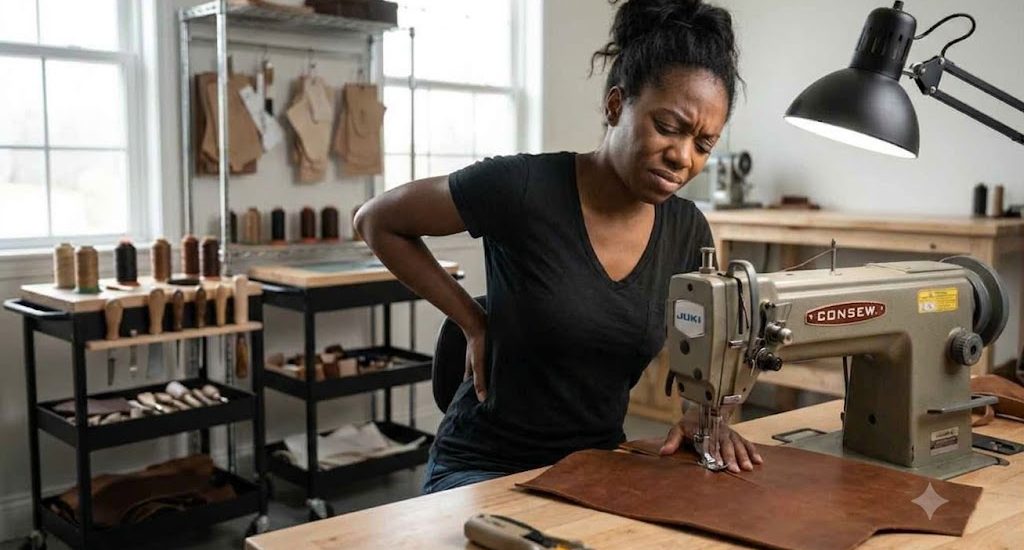
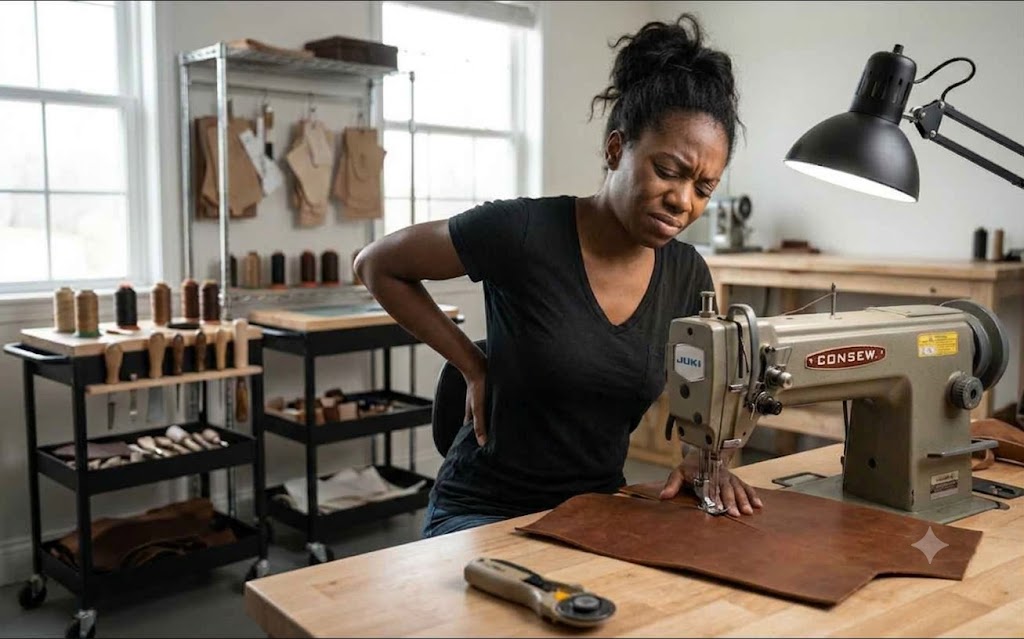
I blew out two discs in my lower back in year six of doing this for a living. Not from lifting hides off a pallet, not from hauling a Juki out of a delivery van — from sitting hunched over a stitching pony for four hours pulling waxed linen thread through 8oz veg-tan, elbows up around my ears, chin dropped like I was trying to read the stitch line through my own sternum. Nobody warns you about this part. Everyone talks about skiving angles and edge burnishing and whether Ritza 25 is worth the money over Tiger thread. Nobody talks about the fact that hand stitching is one of the most repetitive, static-load activities a body can do, and it will find your weak spot and dig in.
So here’s what I actually do now, after physical therapy, after buying and returning three chairs, after finally admitting the problem was never the leather.
Raise your work, not your neck
The single biggest fix I made was clamping my stitching pony to a table that put the work at sternum height, not lap height. Most people set up low because that’s how they saw it done in a workshop video, some guy sitting with the pony between his knees like he’s playing a cello. Fine for twenty minutes. Brutal for a workday. If your chin is dropping toward your chest to see the stitch line, that’s ten to fifteen pounds of extra load on your cervical spine for every hour you’re down there. Get the work up. I use a pony bolted to a rolling stand I built from 2x4s and a bit of scrap ply, adjustable in six-inch increments. Cost me forty bucks in lumber. Saved my neck.
The machine is worse than the hand work
Industrial walking-foot machines — the Consew 206, the Juki 341, the Cobra Class 4 — vibrate. Constantly, low-grade, all day. That vibration travels up through your forearms into your shoulders and neck if your table height forces you to hunch. Your elbows should rest at roughly ninety degrees with your shoulders relaxed, not shrugged. If you’re reaching up for the handwheel or leaning forward to see the presser foot, your table’s too low or your chair’s too low, full stop. I run a hydraulic drafting stool now, not a sewing chair — sewing chairs are built for posture, not for eight-hour days of subtle vibration load, and the lumbar support on most of them is decorative at best.
Change your grip, not just your posture
Awl work is the sneaky one. Pushing an awl through 10oz bridle leather with a diamond point takes real hand strength, and most people compensate by locking their wrist and driving from the shoulder, which torques the whole upper back sideways over hundreds of stitches. Switch your grip. Palm the awl handle like you’re holding a hammer, not a pencil, and let your body weight do the pushing, not your shoulder. It sounds small. It isn’t. It’s the difference between a sore forearm and a rotator cuff that aches for three days.
Break the cycle every twenty minutes, not every two hours
I used to power through a whole gusset panel before standing up. Bad idea. Static posture, even good static posture, stiffens tissue and starves it of blood flow. Set a timer for twenty minutes. Stand, roll your shoulders back, let your arms hang and just shake them out for ten seconds. It costs you almost nothing in productivity and it resets the load before it compounds.
Lighting is a back problem in disguise
If you can’t see the stitch line, you lean in. If you lean in, your neck pays for it. I run a swing-arm task lamp with a daylight-balanced bulb clamped right over the work, not overhead lighting that casts a shadow from my own head. Half the hunching I see in other makers’ shops isn’t posture ignorance — it’s them trying to see what they’re doing under bad light.
None of this is glamorous. Nobody puts “ergonomic table height” in the Instagram caption next to a finished tote. But I’ve watched good makers quit the trade because their body gave out before their skills did, and that’s a waste nobody talks about enough.